
| Rate type | 2026 | From Jan. 1, 2027 |
|---|---|---|
| Non-tipped employees | $11.00 | $11.40 |
| Tipped employees (cash wage, plus tips) | $5.50 | $5.70 |
| Maximum tip credit | $5.50 | $5.70 |
| Applies to businesses with annual gross receipts above | $405,000 | $419,000 |
| Smaller businesses and employees under 16 | $7.25 (federal) | $7.25 (federal) |
Sources: Ohio Department of Commerce releases for 2026 and 2027 (published September 30, 2026), and the official 2027 Ohio minimum wage poster.
Ohio voters approved Constitutional Amendment II-34a in 2006. It raises the wage every January 1 by inflation, measured by the CPI-W for the 12 months ending in August. The 2027 increase is 3.5%, based on the change from September 1, 2025 to August 31, 2026. The 2026 increase was 2.8%. The tipped wage is half of the full rate.
Ohio’s higher rate applies only to employers above a revenue threshold that also rises each year. In 2026, businesses with annual gross receipts of $405,000 or less pay at least the federal $7.25. In 2027 the cutoff becomes $419,000. Employees aged 14 and 15 are also tied to the federal $7.25, whatever the size of the business. For the rest of Ohio’s rules on breaks, minors and final pay, see our Ohio labor laws guide.
A tipped employee is anyone in an occupation who customarily and regularly receives more than $30 a month in tips. You may pay $5.50 an hour in cash in 2026, and $5.70 in 2027, as long as cash wages plus tips reach the full minimum for the hours worked. If tips come up short, you make up the difference. Test a shift with the tip credit calculator and read the tip pooling rules before you share tips with back-of-house staff.
The Ohio poster requires 1.5 times the employee’s wage rate for hours over 40 in a workweek. It excepts employers grossing less than $150,000 a year, although many of those businesses are still covered by the federal FLSA overtime rules. Ohio has no daily overtime.
The same week in 2027 at $11.40 pays $456.00 + (5 x $17.10) = $541.50. For tipped staff, overtime is based on the full rate: in 2026 each overtime hour costs at least $16.50 minus the $5.50 tip credit, or $11.00 in cash. A worker paid $12.00 an hour in 2026 already clears the 2027 minimum, but anyone between $11.00 and $11.39 needs a raise on January 1.
A full-time employee at 40 hours a week for 52 weeks works 2,080 hours. Moving that worker from $11.00 to $11.40 adds $832 a year in base wages before payroll taxes. For a tipped employee, the $0.20 rise in the cash wage adds $416 a year.
| State | Basic minimum wage (Nov. 2026) |
|---|---|
| Ohio | $11.00 (larger employers) |
| Michigan | $13.73 ($15.00 on Jan. 1, 2027) |
| West Virginia | $8.75 |
| Pennsylvania, Indiana, Kentucky | $7.25 |
Figures from the U.S. Department of Labor state table, updated November 5, 2026.
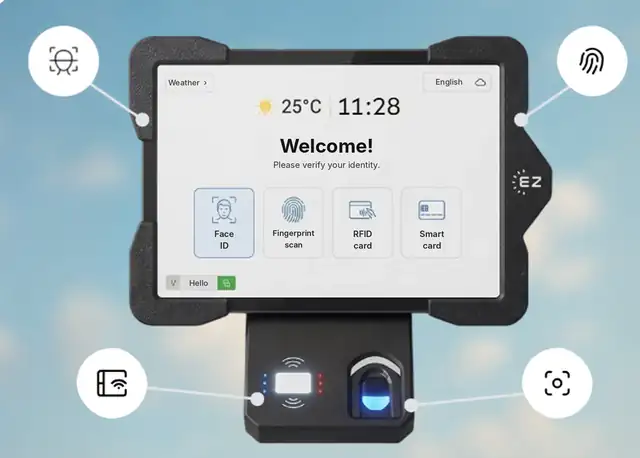
EZTime’s GPS time clock app records punches by phone, kiosk or NFC tap, flags overtime before it happens and builds payroll-ready exports. Use shift scheduling to keep labor costs in line after the raise.
$11.00 per hour for non-tipped employees and $5.50 per hour plus tips for tipped employees, at businesses with annual gross receipts above $405,000.
$11.40 per hour, and $5.70 plus tips for tipped employees, from January 1, 2027, for businesses grossing more than $419,000, according to the Ohio Department of Commerce.
No. Businesses at or under the gross receipts threshold pay at least the federal $7.25. The same applies to employees aged 14 and 15.
Get ready for Ohio’s 2027 rate. Start your 14-day trial or book a demo.
Updated November 2026. Rates verified against official state sources on November 14, 2026. General information only; not legal advice.