
| Standard (a.m.) | Military | Standard (p.m.) | Military |
|---|---|---|---|
| 12:00 a.m. | 0000 | 12:00 p.m. | 1200 |
| 1:00 a.m. | 0100 | 1:00 p.m. | 1300 |
| 2:00 a.m. | 0200 | 2:00 p.m. | 1400 |
| 3:00 a.m. | 0300 | 3:00 p.m. | 1500 |
| 4:00 a.m. | 0400 | 4:00 p.m. | 1600 |
| 5:00 a.m. | 0500 | 5:00 p.m. | 1700 |
| 6:00 a.m. | 0600 | 6:00 p.m. | 1800 |
| 7:00 a.m. | 0700 | 7:00 p.m. | 1900 |
| 8:00 a.m. | 0800 | 8:00 p.m. | 2000 |
| 9:00 a.m. | 0900 | 9:00 p.m. | 2100 |
| 10:00 a.m. | 1000 | 10:00 p.m. | 2200 |
| 11:00 a.m. | 1100 | 11:00 p.m. | 2300 |
Minutes do not change. Convert the hour, then add the same minutes:
To go back, subtract 12 from any hour of 13 or more: 1850 is 6:50 p.m.
Overnight shifts are where a.m. and p.m. mistakes cost money. A shift from 2200 to 0600 is clearly 8 hours; written as 10:00 to 6:00, it is easy to misread. Many time clocks show punches in 24-hour time for this reason. See overnight shift time tracking and the second shift guide.
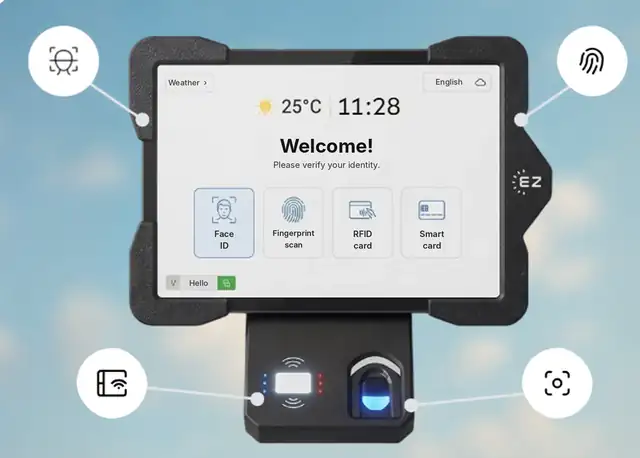
Convert a single time with the military time converter, turn minutes into decimals with the timesheet conversion chart, or let EZTime record clock-ins and total hours automatically.
1900.
1645.
1100.
0100.
If the hour is 13 or more, subtract 12 and add p.m. 1715 is 5:15 p.m.
Clock-ins recorded and totaled for you. Start your 14-day trial or book a demo.
Updated November 2026.