
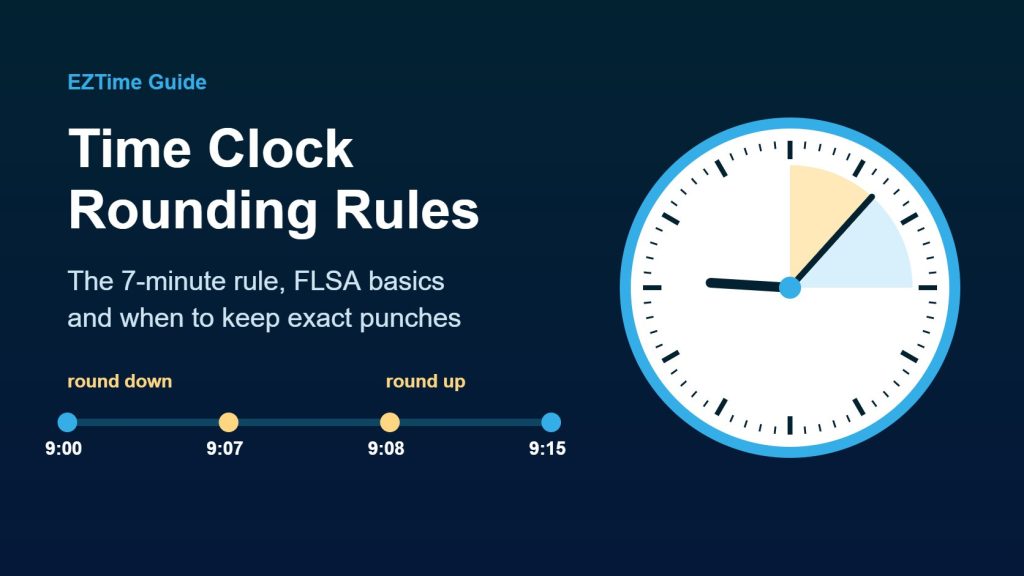
Short answer: Under the federal Fair Labor Standards Act (FLSA), employers may round employee time clock punches to the nearest 5 minutes, tenth of an hour, or quarter hour, as long as the rounding is neutral and, over time, employees are paid for all the time they actually worked. The well-known “7-minute rule” is simply how quarter-hour rounding works: 1 to 7 minutes rounds down, 8 to 14 minutes rounds up. Some states, especially California, look at rounding much more strictly, and many employers now simply pay from exact punches.
This guide explains how time clock rounding works, where employers get into trouble, and how to decide whether rounding still makes sense for your business. It is general information for US employers, not legal advice. For decisions about your own policy, check with an employment attorney or your state labor department.
What is time clock rounding?
Time clock rounding means adjusting an employee’s recorded clock-in or clock-out time to a set interval before calculating pay. Instead of paying from 8:56 a.m. to 5:04 p.m., for example, an employer using quarter-hour rounding would pay from 9:00 a.m. to 5:00 p.m.
Rounding became common when employers used mechanical punch clocks and calculated hours by hand. Whole and quarter-hour totals were easier to add up on paper timecards. Today, most digital time clocks record the exact minute of every punch, which is one reason the practice is getting more scrutiny.
What the FLSA says about rounding
The Department of Labor’s regulation on time clocks, 29 CFR 785.48, addresses rounding directly. In plain terms, it says:
- Rounding to the nearest 5 minutes, the nearest tenth of an hour (6 minutes), or the nearest quarter of an hour (15 minutes) is an accepted practice for enforcement purposes.
- The practice is acceptable only if it averages out so that employees are fully compensated for all the time they actually work over a period of time.
- Separately, minor differences between punch times and scheduled times, such as an employee clocking in a few minutes early but not starting work until the shift begins, may not need to be counted as hours worked, as long as the employee is not actually working during that time.
The key word is neutral. A rounding policy has to work in both directions. If it only ever rounds in the employer’s favor, or if it is applied in a way that consistently trims paid time, it can lead to unpaid wage and overtime claims.
The 7-minute rule explained
The 7-minute rule is the common name for quarter-hour rounding. Each hour is split into 15-minute segments, and a punch is rounded to the nearest segment:
- 1 to 7 minutes past a quarter hour rounds down to that quarter hour.
- 8 to 14 minutes past a quarter hour rounds up to the next quarter hour.
Examples
- An employee clocks in at 8:53 a.m. That is 8 minutes past 8:45, so the punch rounds up to 9:00 a.m.
- An employee clocks in at 9:07 a.m. That rounds down to 9:00 a.m.
- An employee clocks out at 5:08 p.m. That rounds up to 5:15 p.m.
- An employee clocks out at 5:06 p.m. That rounds down to 5:00 p.m.
Applied evenly, some punches gain a few minutes and others lose a few. The problem starts when the pattern stops being even.
Where rounding policies go wrong
Rounding is legal at the federal level, but it is also a frequent source of wage and hour disputes. These are the patterns to watch for:
Rounding only in one direction
A policy that always rounds clock-ins forward and clock-outs back is not neutral. Neither is a policy that rounds down at clock-out but requires employees to be “on the clock” before the rounded start time.
Rules that push employees to punch at certain times
If employees are told to clock in no earlier than 7 minutes before the shift, but late punches are disciplined, the punches will cluster on the side that favors the employer. Over months, that can add up to unpaid time even though the policy looks neutral on paper.
Work happening off the rounded clock
Rounding does not change the basic rule that time spent working must be paid. If an employee clocks in early and starts opening the store, setting up a job site, or answering customer calls, that is work time, regardless of how the punch is rounded.
Rounding meal breaks
Rounding meal break punches can make a 27-minute break look like a full 30 minutes. In states with meal period requirements, that can create compliance problems on its own.
Never checking the results
The FLSA standard is about results over time. An employer that never compares rounded hours against actual punches has no way of showing that the policy averages out.
State rules can be stricter
The FLSA sets a federal floor. States can add their own requirements, and employers must follow whichever rule is more protective for employees.
California is the best-known example. In Donohue v. AMN Services (2021), the California Supreme Court held that employers cannot round time punches for meal periods. California courts have also questioned rounding of regular shift punches when an employer’s system already captures exact times. As a result, many California employers have stopped rounding altogether and pay from exact punches.
Other states have their own rules on meal and rest breaks, recordkeeping, and overtime. If you have employees in more than one state, review your policy against each location’s requirements rather than assuming one approach works everywhere.
Should you still round time punches?
For many US employers, the honest answer is: probably not anymore. Rounding solved a math problem that digital time tracking has already solved. When your time clock records every punch to the minute and calculates totals automatically, paying from exact time is usually simpler to explain and easier to defend.
Paying exact time has a few practical advantages:
- Fewer disputes. Employees can see that the hours on their paycheck match the punches they made.
- No averaging audits. You do not need to prove that rounding evened out over time.
- Cleaner overtime tracking. Small daily differences do not quietly push someone over 40 hours in a workweek without anyone noticing.
Many employers manage early clock-ins differently instead: they set a policy on when employees may clock in, require manager approval for work outside scheduled hours, and review exceptions before payroll. That keeps labor costs in check without trimming time employees actually worked.
A checklist for any rounding or punch policy
Whether you round or pay exact time, these steps help keep your timekeeping consistent and defensible:
- Write the policy down. State the interval (if any), how punches are rounded, and how early employees may clock in.
- Apply it to everyone the same way. Do not make exceptions by manager or location without a documented reason.
- Keep the original punches. Store the exact clock-in and clock-out times, not only the rounded totals.
- Exclude meal breaks from rounding, especially in states with meal period rules.
- Compare rounded and actual hours regularly. If rounding consistently reduces paid time for an employee or group, change the policy.
- Train managers on off-the-clock work. Make it clear that any work performed must be recorded and paid.
- Have a clear correction process. Employees should know how to report a missed punch or timecard error, and managers should document every change.
- Review overtime before payroll closes. A short overtime exception review catches problems while they are still easy to fix.
How a digital time clock helps
The hardest part of any timekeeping policy is following it consistently across shifts, managers, and locations. A digital time clock takes much of the manual work out of that.
With EZTime’s employee time clock, employees clock in and out from the EZTime mobile app with GPS location, and every punch is recorded with its time. Managers review timesheets in one place, get overtime and break alerts, and export payroll-ready reports instead of adding up paper timecards. That makes it practical to pay from exact punches and to spot unusual clock-in patterns before payroll. If you are building a full prep routine, see our guide to an hourly payroll prep workflow.
EZTime plans start at $2 per employee per month. You can compare plans on the pricing page or start a 14-day free trial.
Skip rounding with exact punches
EZTime records punches to the minute and lets employees request corrections with manager approval.
Frequently asked questions
Is time clock rounding legal in the US?
Under federal law, yes. The FLSA allows rounding to the nearest 5 minutes, tenth of an hour, or quarter hour if the practice is neutral and employees are fully paid for time worked over a period of time. Some states apply stricter standards, so check the rules where your employees work.
What is the 7-minute rule for time clocks?
It is the rule of thumb for quarter-hour rounding. A punch 1 to 7 minutes past a quarter hour rounds down, and a punch 8 to 14 minutes past rounds up to the next quarter hour.
Can employers always round down?
No. A policy that only rounds in the employer’s favor is not neutral and can result in unpaid wages and overtime. Rounding must work both ways and average out over time.
Can I round meal break punches?
It is risky. In California, the state Supreme Court has said meal period punches cannot be rounded. In other states, rounding meal breaks can still hide short breaks. Many employers record exact break times instead.
Is rounding the same as the de minimis rule?
No. Rounding is a payroll calculation applied to punch times. The de minimis concept covers small amounts of time that cannot practically be recorded. Regular, recordable work time, even if it is only a few minutes a day, generally needs to be counted.
Do I need to keep the original punch times?
Keeping the exact punches is strongly recommended. Without them, you cannot show that a rounding policy averages out, and you have less information if a pay question comes up later.
Related US labor guides
- California meal and rest break rules
- FLSA overtime rules explained
- Predictive scheduling (Fair Workweek) laws
- PTO accrual and PTO policy guide
- Free weekly timesheet template (Excel)
This article is general information about US timekeeping practices and is not legal advice. Labor laws change and vary by state and city, so confirm requirements with a qualified professional before changing your pay practices.